Capsule Polishers for Every Pharma and Supplement Line
Powder Off. Shells Clean. Line Moving.
Capsule polishing machines for pharmaceutical manufacturers, nutraceutical and supplement makers, contract encapsulators and softgel producers. A soft brush takes the loose powder off every filled capsule and a vacuum carries it away, before it can reach the packaging line.
These are production machines for filled capsules. The eye surgery instrument called a capsule polisher is a different product, and this site does not cover it.
Why filled capsules need polishing
In a pharmaceutical or nutraceutical plant, the capsule filler leaves powder behind. It sits on the shell, sometimes held there by static, and it tends to gather at the rim where the cap meets the body.
Plants once cleaned capsules in pans of salt or with cheesecloth. A polisher does the job in line and needs no chemicals or disposable products.


Off the filler: powder on the shell and at the rim.
After polishing: a clean shell and a crisp seam.
- Packaging lines stop
- Dust that rides along with the capsules can cover sensors and work into gears and belts. That means downtime and more maintenance on the packaging line.
- Packs do not seal
- The same dust can keep bottles and blisters from sealing properly.
- Dusty capsules look wrong
- If capsules do not look clean, patients may not take them as directed.
- Dust has to be controlled
- EU GMP asks for specific provisions wherever dust is generated, to avoid cross-contamination and make cleaning easier.
How a capsule polisher works
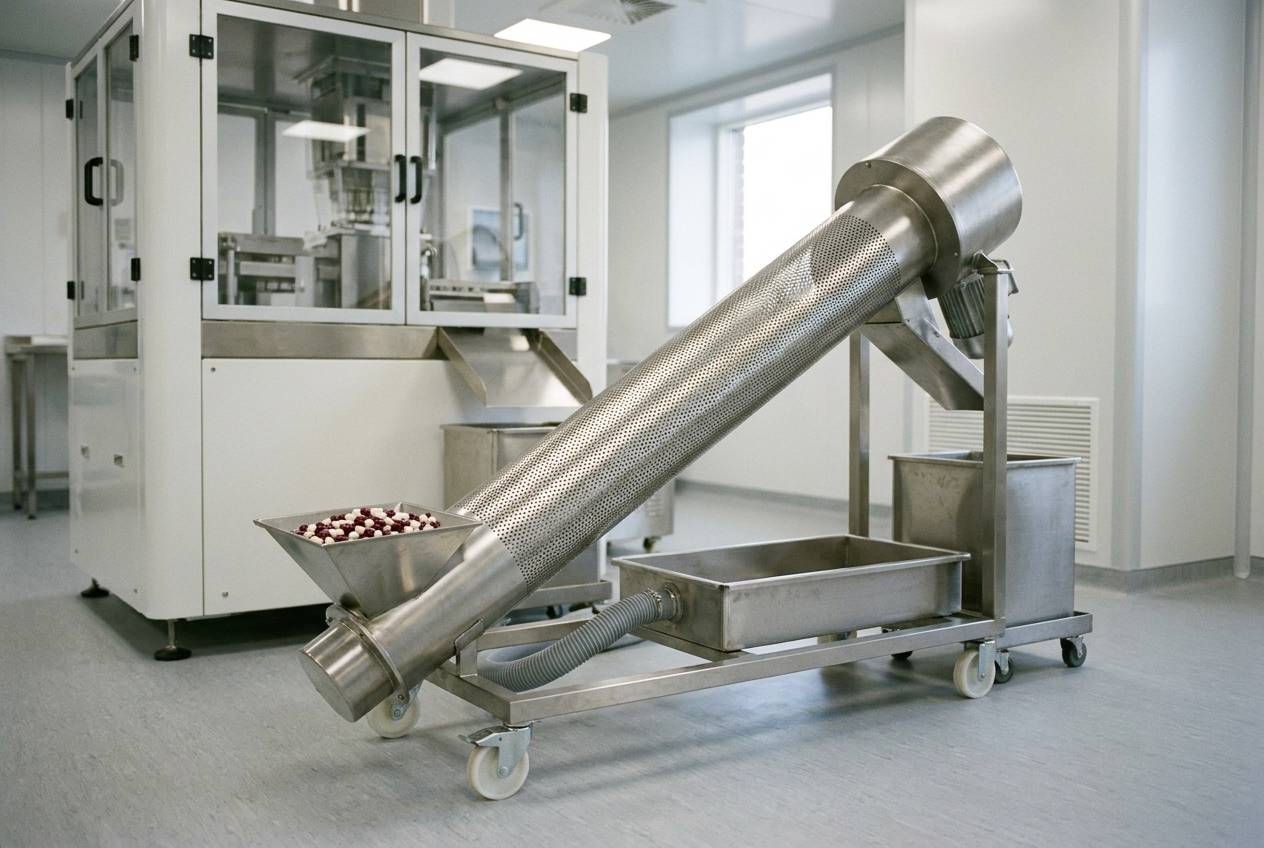
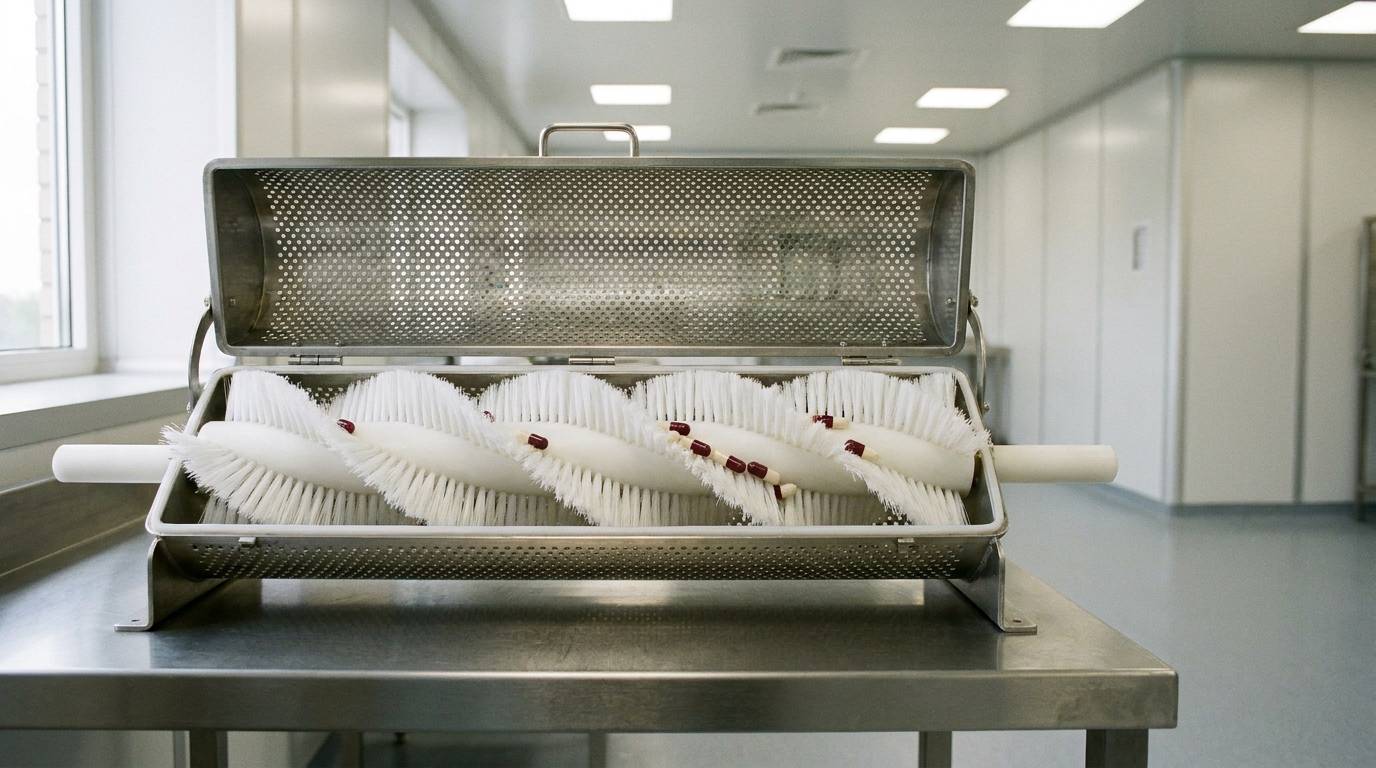
The capsules ride a turning brush along a tube with holes in its wall. The brush loosens the powder, the holes let it out, and suction takes it away. Dusty capsules go in at one end and clean ones come out at the other.
- Infeed
- Capsules arrive from the filler through a hopper, or through a hose clamped straight onto the inlet.
- Spiral brush
- A soft nylon brush wound in a spiral turns inside the tube. It carries the capsules along and rubs the powder off as they go.
- Perforated housing
- Holes or a net in the tube wall give the loosened powder a way out of the capsule stream.
- Vacuum
- Suction pulls the powder out through a dust port to a vacuum unit or dust collector. One published port is a 2 inch sanitary clamp.
- Drive
- A geared motor with variable speed, set to keep pace with the filler.
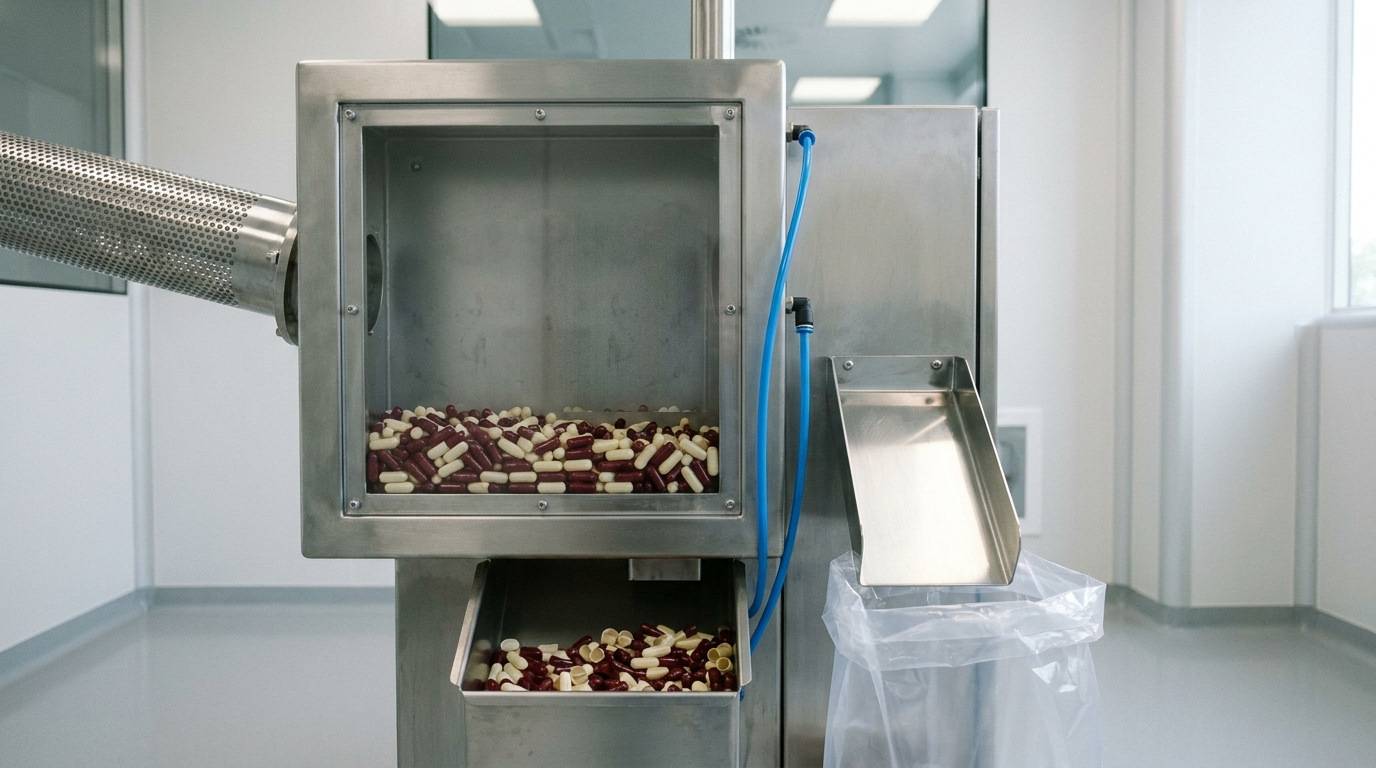
- Outlet
- Clean capsules leave here, into a bin or on to a metal detector, sorter or diverter.
What the speed ratings mean
Published ratings run from about 90,000 to 400,000 capsules an hour. A filler at full speed on size 00 makes about 3,000 a minute, or 180,000 an hour, so compare the rating with your filler's top speed and not its average.
These are makers' own figures, and only some state the capsule size behind them. Ask which size was used. A rating based on size 2 may not hold for size 00.
Inclined, vertical and combined machines
All of them brush and vacuum. They differ in how the capsules travel and in what is fitted to the outlet.
| Type | How it works | Good for | Watch for |
|---|---|---|---|
| Inclined brushThe tube sits at an angle | How it works: The spiral brush carries capsules up a tube set at an angle, traditionally around 30 degrees. Height and angle adjust to meet the filler's chute. | Good for: Running inline after a filler or on its own for batch work. Many sit on a wheeled stand and can move between rooms. | Watch for: One equipment specialist reports that powder left in the low end of the tube gets picked up by the brush again. |
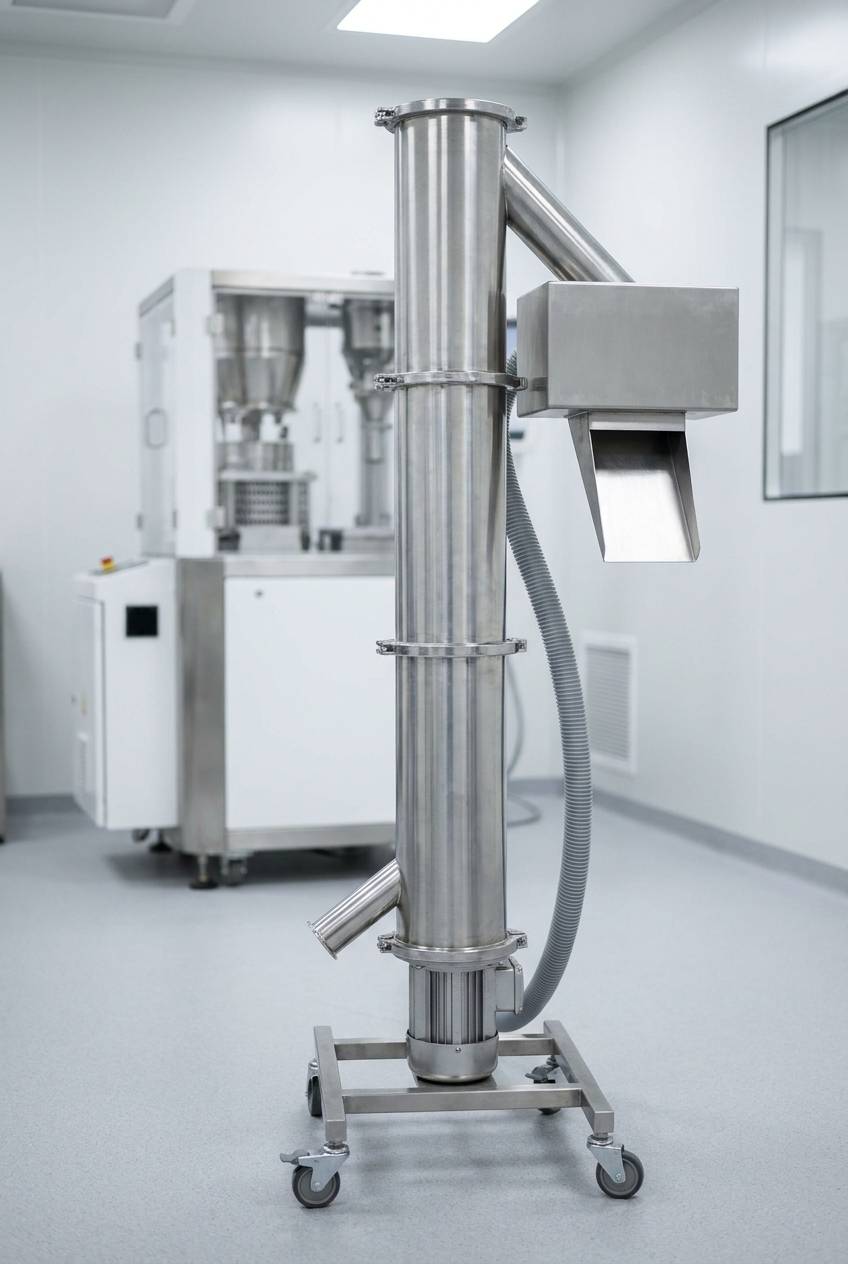
| VerticalAlso called uphill | How it works: A helical brush lifts capsules straight up against a controlled vacuum, and the powder is drawn off through the housing. | Good for: Gaining height on a small footprint, so the outlet can feed a metal detector, a sorter or a larger bin. | Watch for: Headroom and the outlet height. One maker lists elevations of 800 to 2,000 mm, with outlets at about 1.3 to 2.5 m. |
| Polisher with sorterEither layout | How it works: A separator at the outlet rejects empties, loose caps, fragments and light capsules, usually with compressed air. | Good for: Catching empties before they reach a bottle or blister and force a pack to be pulled and reworked. | Watch for: Many sorters need compressed air on top of vacuum. Published figures are about 0.25 to 0.3 cubic meters a minute at 0.3 MPa. |
| Polisher with metal detectorUsually vertical | How it works: The detector sits on the polisher outlet, with a diverter to take out any capsule that trips it. | Good for: Removing a single capsule at this stage. After packaging, a whole blister, bottle or carton has to come out instead. | Watch for: How rejects are diverted and collected, and how the detector's own checks fit your batch routine. |
Why some plants go vertical
A vertical machine also works as a lift. Capsules leave the filler low and arrive high enough to drop through a metal detector or into a bigger bin, without a separate conveyor.
One equipment specialist also argues it polishes cleaner. Powder falls to the bottom of the column and is vacuumed away, so it does not build up between the brush and the tube, where on an inclined machine it can wear printed markings and get pushed into the capsule joint. Trial your own capsules before you take that as settled.
Where a polisher sits in the line
The polisher goes straight after the filler, so the powder comes off before anything downstream can pick it up.
Filling
The filler doses the product and closes the shells.
Polishing
Brush and vacuum take off the loose powder while the capsules keep moving.
Metal check
A detector straight after the polisher can reject one capsule at a time.
Empty capsule sorting
Empties, loose caps and fragments come out before packaging.
Packaging
Clean capsules go on to bulk containers, bottles or blisters.
Why the checks come before packaging
At the polisher outlet the capsules are still loose, so a metal detector or sorter can reject one at a time. Once they are in blisters or bottles, a single fault means pulling the whole pack.
Lines vary. Some run the sorter ahead of the detector and some fit both on the polisher itself, so check what suits your layout.
Capsule sizes and the machine
Hard capsules run from size 000, the largest, down to size 5. Makers commonly list 00 to 4, some say any size, and size 5 can be a special order.
They also disagree on changeover. Some machines use a different brush and screen for each size, with quick-change assemblies. Others say no change parts are needed. Settle this before you order, because it decides how long a size change takes.
| Size | Closed length, mm | Cap diameter, mm | Volume, mL |
|---|---|---|---|
| 000 | 26.1 | 9.91 | 1.37 |
| 00 | 23.3 | 8.53 | 0.91 |
| 0 | 21.7 | 7.64 | 0.68 |
| 1 | 19.4 | 6.91 | 0.50 |
| 2 | 18.0 | 6.35 | 0.37 |
| 3 | 15.9 | 5.82 | 0.30 |
| 4 | 14.3 | 5.32 | 0.21 |
| 5 | 11.1 | 4.91 | 0.13 |
From one shell maker's published chart for gelatin capsules. Other makers' figures differ slightly, so use your own supplier's data for any setup.
Softgels are polished differently
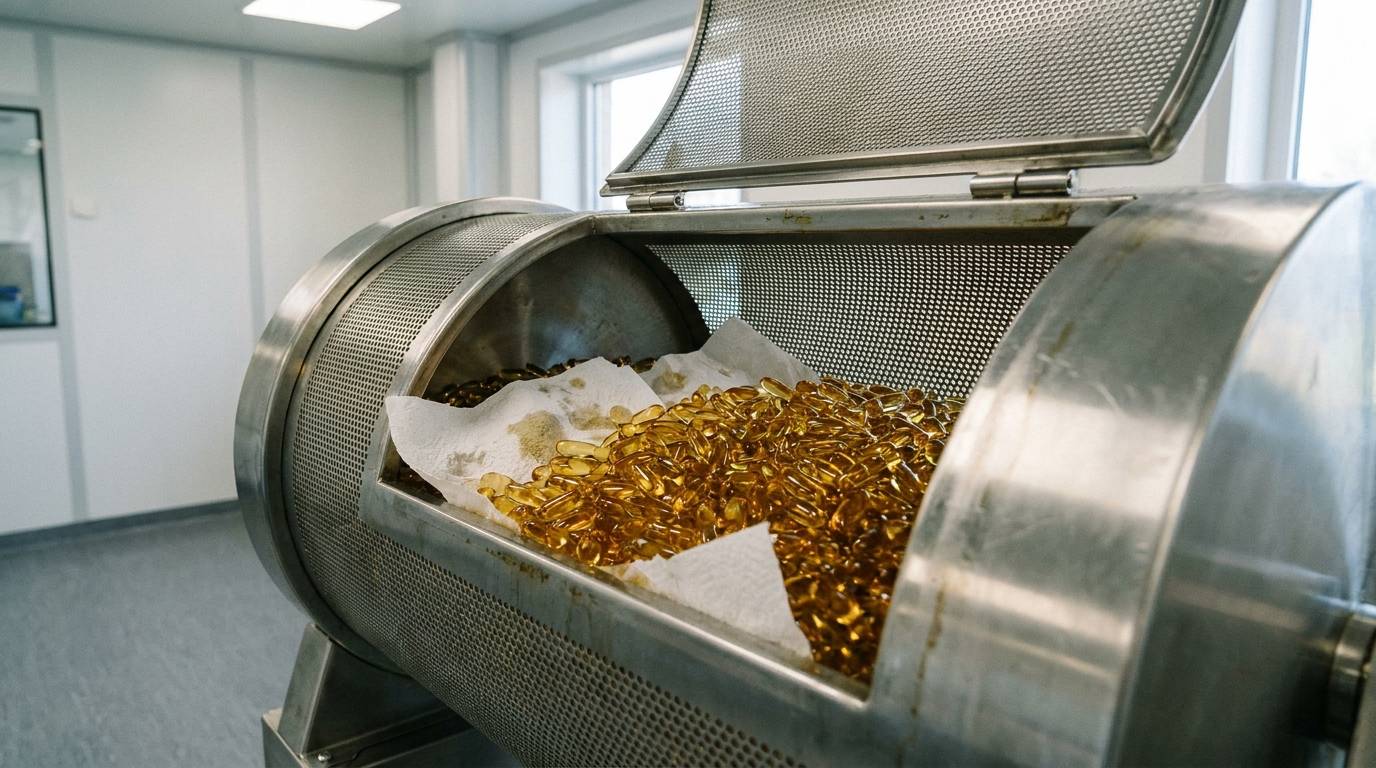
A softgel comes off the line with oil on it, not powder. Encapsulation machines use mineral or MCT oil to lubricate the gelatin ribbons, and that oil stays on the shell along with any fill that leaked.
So the job is to lift oil rather than brush off dust. Cleaning and polishing come after drying, as the last step before packaging.
- Cloth towels
- Some manufacturers clean with towels sprayed with ethanol, then polish with dry towels. Ethanol is volatile, which brings environmental and safety concerns of its own.
- Oiled towels in a drying basket
- Capsules tumble in the basket with towels soaked in oil. In one published pilot study on a multivitamin, mineral and fish oil softgel, MCT oil cleaned best, mineral oil left a dull surface, and adding 1 percent lecithin to either did not help.
- Continuous vibrating polisher
- Capsules travel along a vibrating conveyor between layers of low-lint absorbent media that take the oil off. One such system launched with a claimed rate of 900,000 capsules an hour.
Dust collection and containment
A polisher moves the powder off the capsule and into your vacuum line. Plan where it goes next, and check whether the dust itself needs special handling.
- Vacuum
- Published figures are about 2.7 to 3.0 cubic meters a minute at around 0.01 MPa of suction. At least one maker advises a separate dust collector or cyclone separator as well, even on machines with internal separation.
- Potent products
- At least one maker's vertical polishers have been independently tested to OEB 3 and OEB 4 containment levels under ISPE SMEPAC requirements. If your product needs that, ask to see the test report.
- Combustible dust
- OSHA lists pharmaceuticals among the materials that can form combustible dust. Have your safety team look at the hose and collector as part of your dust hazard review, and ask which explosion protection certificates the machine carries. ATEX is the European scheme.
Cleaning, changeover and GMP
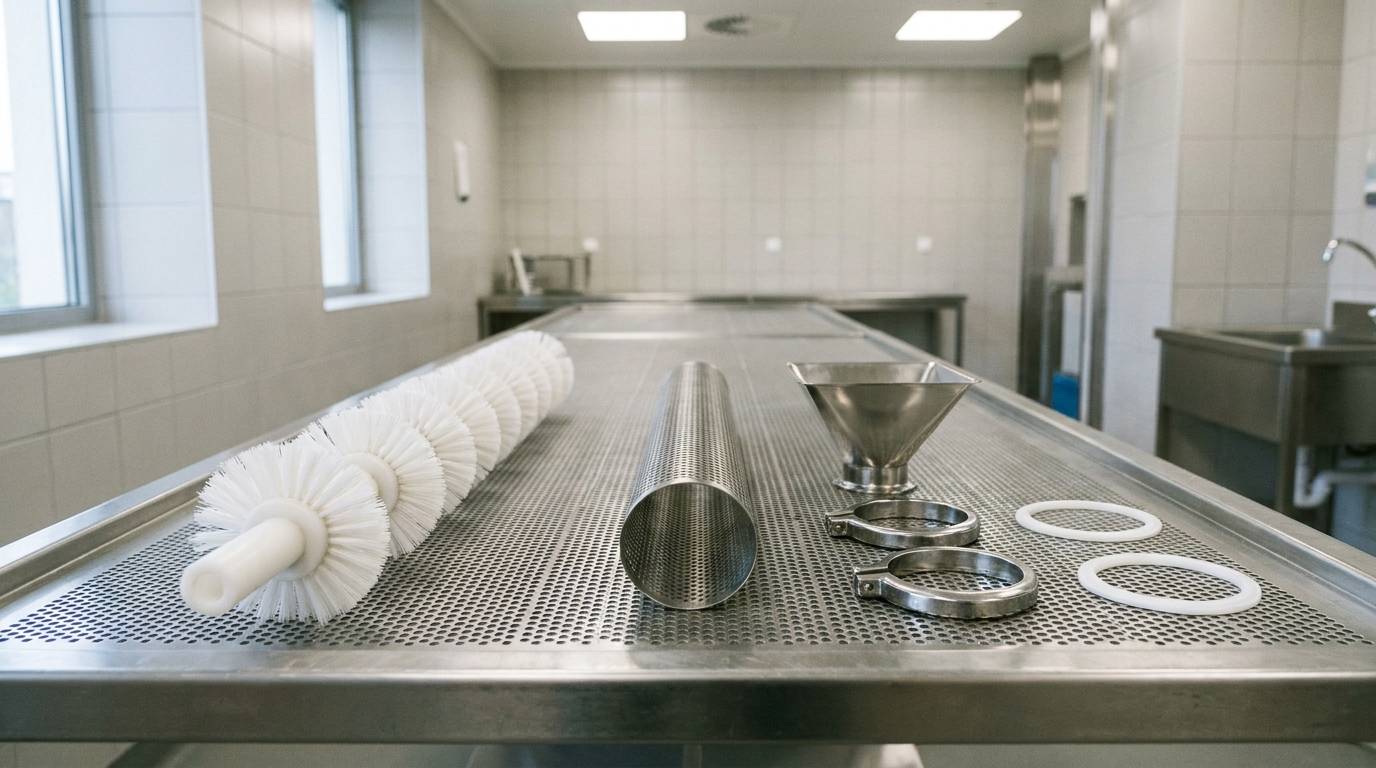
Everything the capsules touch has to come apart, get washed and go back together the same way every time. Some machines need no tools for this. On some you can mark each brush section to keep it with one product.
Contact parts are stainless, with 316L on some machines and 304 on others. Brushes are nylon, and the housing may be a stainless net or a smooth polyester one.
| Rule | What it asks for | What it means here |
|---|---|---|
| 21 CFR 211.63 | Asks for: Drug equipment must be of appropriate design and adequate size, and suitably located for its use and for cleaning and maintenance. | Here: Leave room to open the tube, pull the brush and wheel the machine out. |
| 21 CFR 211.65 | Asks for: Contact surfaces must not be reactive, additive or absorptive. Lubricants must not reach the product so as to alter it. | Here: Get the contact materials in writing and ask how the drive shaft is sealed. |
| 21 CFR 211.67 | Asks for: Written cleaning procedures, including how to take equipment apart and put it back, keep it protected once clean and inspect it before use, plus records. | Here: A machine that strips down without tools keeps that procedure short. |
| 21 CFR 111.27 | Asks for: For dietary supplements: equipment must suit its use and clean properly, be corrosion-resistant and nontoxic, and have seams smoothly bonded or maintained. | Here: Supplement makers face the same design questions, so ask the same ones. |
| EU GMP Chapter 3 | Asks for: Equipment should be easily and thoroughly cleaned and stored clean and dry. Contact parts must not be reactive, additive or absorptive. | Here: Think about where the clean brush and tube will be kept between batches. |
| EU GMP Annex 15 | Asks for: Covers installation, operational and performance qualification, and calls for cleaning validation on all product contact equipment. | Here: The brush is product contact. Ask which qualification documents come with the machine. |
Summaries for orientation only. Read the rule itself, and let your quality team decide how it applies to your plant.
Common problems and what to check
| Problem | Likely cause | What to check |
|---|---|---|
| Printing wears off | Likely cause: Powder left in the tube can end up on the brush, which then sands the ink. One specialist reports this on inclined machines. | Check: Keep the tube clean and run your actual printed shell in a trial. Ask how the machine keeps capsules off the metal net. |
| Powder stays at the rim | Likely cause: Residue in the low end of an inclined tube can be pushed back into the joint between cap and body. | Check: Clear the low end more often, or compare a vertical machine. |
| Dust clings to the shell | Likely cause: Static can hold dust on a capsule. | Check: Ask about an ionizing air probe, which at least one maker offers as an option. |
| Capsules jam | Likely cause: Steps between brush sections, or a brush and screen that do not suit the capsule size. | Check: Check the size setup, and ask how the brush sections join. |
| Polish gets worse over time | Likely cause: Brushes wear. One maker gives a working life of 6 to 12 months, depending on volume and product. | Check: Keep a spare set and put the brush on the maintenance plan. |
| Empties reach the packaging line | Likely cause: No sorter on the line, or a sorter that needs resetting for this product. | Check: Sort before packaging, while a reject is still a single capsule. |
Before you ask for a quote
Six things a supplier will ask, so have them ready.
- Capsule sizes and shells
- List every size you run, the shell material, and which shells are printed.
- Line rate
- Use your filler's top speed, and ask which capsule size the polisher's rating assumes.
- The fill
- Note what you fill and how potent it is. That decides the containment you need.
- Connection at the filler
- Measure the discharge height and chute. The polisher's height and angle, or an inlet adapter, has to meet them.
- What comes next
- A bin, metal detector, sorter or diverter. Each one sets the outlet height.
- Utilities
- Voltage, the vacuum source, and compressed air if a sorter or brush air clean is fitted. Published machines run on 110 V or 230 V.
Buying checklist
- Rated speed stated for your capsule size
- Size range confirmed, including any special order sizes
- Change parts per size, or a written statement that none are needed
- Contact material grade in writing (316L and 304 are both sold)
- Brush material, and how the net or screen treats printed shells
- Strip-down without tools, and how many parts there are to wash
- Variable speed, and a signal link to the filler if you want one
- Dust port size and fitting that match your collector
- Sorter or metal detector included, or a route to add one later
- Containment test report, if your product needs one
- Explosion protection certificate, if your dust needs one
- Noise at 1 m (one published figure is under 68 dB(A))
- Qualification documents and cleaning instructions
- Spare brush availability and lead time
- On a used machine: brush, net and shaft seal condition, and what it last ran
Capsule polisher questions
Information only. This is general information, not engineering or regulatory advice. Check everything against your supplier's documents and your own quality system.
What does a capsule polisher do?
It takes the loose powder off the outside of filled capsules. A soft rotating brush moves the capsules along and rubs the shells clean, and a vacuum carries the dust away. The capsules come out clean and with a better shine, ready for metal detection, sorting or packaging.
Is a capsule polisher the same as a capsule deduster?
In practice, yes. Makers use polisher, deduster and polishing machine for the same equipment, because one pass does both jobs. A tablet deduster is a different machine built for tablets.
How fast are capsule polishers?
Published ratings run from about 90,000 to 400,000 capsules an hour. These are makers' own figures, and only some say which capsule size they assume, so ask. A filler at full speed on size 00 makes about 3,000 capsules a minute, or 180,000 an hour.
Should I choose an inclined or a vertical polisher?
An inclined machine is the traditional layout and adjusts to meet most filler chutes. A vertical machine lifts capsules as it polishes, so it can feed a metal detector or a sorter on a small footprint. Vertical designs also keep powder from collecting between the brush and the tube, according to one equipment specialist who favors them, so trial your own capsules on both if you can.
Can a polisher also sort capsules?
Many can. A separator at the outlet rejects empties, loose caps, fragments and light capsules, usually with compressed air. On some machines you can add one later.
Does a capsule polisher need a vacuum?
The makers we reviewed all use vacuum to remove the powder, either from a vacuum cleaner or a plant dust collection line. At least one recommends a separate dust collector or cyclone separator, even on machines with internal separation.
Which capsule sizes can one machine handle?
Makers commonly list sizes 00 to 4, and some say any size. Size 5 can be a special order. Some machines need a different brush and screen for each size, with quick-change parts, and others say no change parts are needed. Confirm your sizes in writing.
How often do the brushes need replacing?
One maker gives a typical brush life of 6 to 12 months, depending on production volume and the product. Some machines let you mark brush sections so they stay with one product.
How are softgels polished?
Softgels carry oil on the shell, not powder, so the methods are different. Plants use cloth towels, oiled towels tumbled with the capsules in a drying basket, or continuous vibrating systems with absorbent media. Cleaning and polishing is the last step before packaging.
Which rules apply to a capsule polisher in the US?
For drugs, 21 CFR Part 211 covers equipment design, construction, cleaning and maintenance, in sections 211.63, 211.65 and 211.67. For dietary supplements, 21 CFR 111.27 covers equipment and utensils. Your quality team decides how these apply to your plant.
Is this site about the surgical capsule polisher?
No. The same name is used for a small hand instrument in eye surgery, which is a different product. This site covers only machines that polish filled capsules in pharmaceutical and nutraceutical manufacturing.
Get a quote on a capsule polisher
Tell us what you fill, your capsule sizes and your line rate. New, used and rebuilt machines are all fine to ask about.
Quotes come directly from suppliers able to help.